
TREE DATA STRUCTURE
In this blog post will study what is a tree data structure, types, applications and basic operations on tree ADT.
Definition
A tree is a data structure similar to a linked list but instead of each node pointing to the next node in a linear fashion, each node points to a number of nodes. Tree is an example of a non-linear data structure.
A tree structure is a way of representing the hierarchical nature of a structure in a graphical form. In trees ADT (Abstract Data Type), the order of the elements is not important.
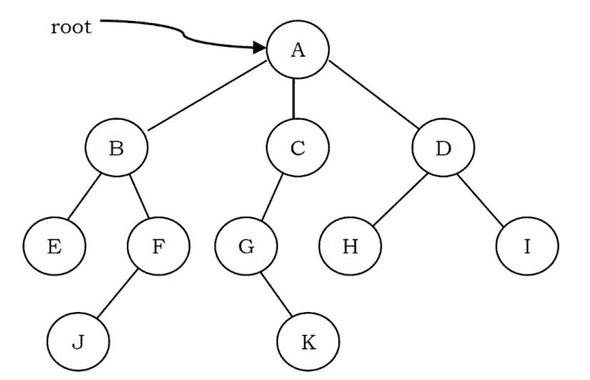
Terminologies
- Root: The root of a tree is the node with no parents. There can be at most one root node in a tree (node A in the above example).
- Edge: An edge refers to the link from parent to child (all links in the figure).
- Leaf Node: A node with no children (E,J,K,H and I).
- Siblings: Children of same parent (B,C,D are siblings of A, and E,F are the siblings of B).
- Ancestor: A node P is said to be the ancestor of node Q if there exists a path from node P to Q. Likewise, node Q is said to be the descendant of node P (B is an ancestor of J).
Properties
- Height of a node: The height of a node is the length of the path from that node to the deepest node (height of G is 1, G - K).
- Depth of a node: The depth of a node is the length of the path from the root to the node (depth of G is 2, A – C – G).
- Height/Depth of a tree: It is the length of the path from the root to the deepest node in the tree (Height/Depth of tree for above example is 4).
- In a tree, if there are N nodes then there will be N-1 edges.
Types
- General Tree
- Binary Tree
- AVL Tree
- Spanning Tree
- B-/B+ Tree
- Skew Tree
- Heap
In this series, we shall see about binary trees and heap only.
Applications
- Store hierarchical data like folder structure, organization structure data.
- Heap is a tree data structure which is implemented using arrays and used to implement priority queues.
- B- Tree and B+ Tree are used to implement indexing in databases.
- Used to store router-tables in routers.
- Used to implement expression parsers and expression solvers.
Basic Operations
- Inserting an element into a tree.
- Deleting an element from a tree.
- Searching for an element.
- Traversing the tree(BFS/DFS).
That's it from this blog post. If you liked it then do share this blog with your friends or people who wanna get into programming world. Thank You!